The short answer
- List one account’s last 12 to 30 posts in one format, take the median of their results, and divide each post’s result by that median.
- Posts at 2× or more are worth studying. Posts at 5× or more are rare; check for paid reach or a giveaway first.
- Score posts only once they are old enough. A post two days old has not finished collecting views.
- The method needs a spreadsheet and about 20 minutes an account. The template and calculator on this page do the arithmetic.
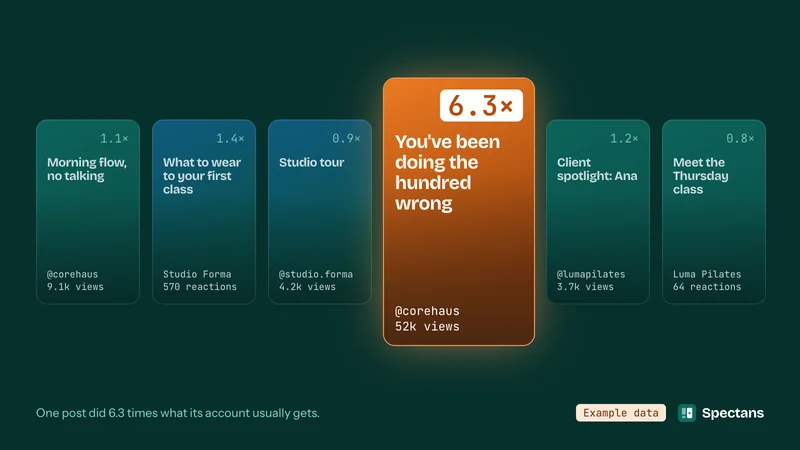
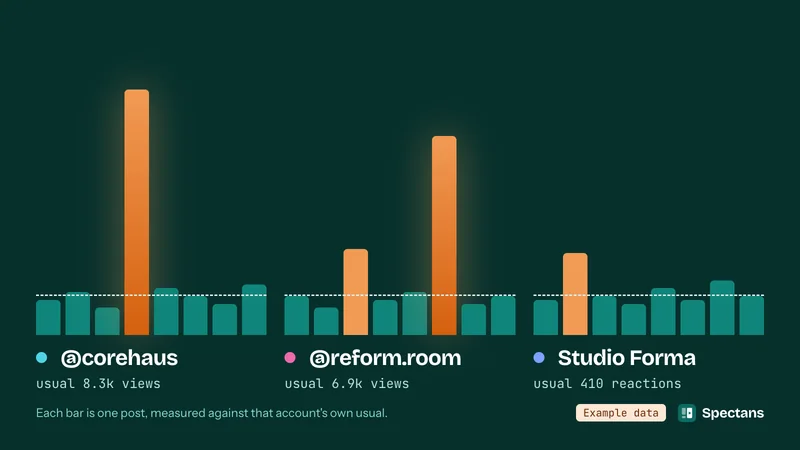
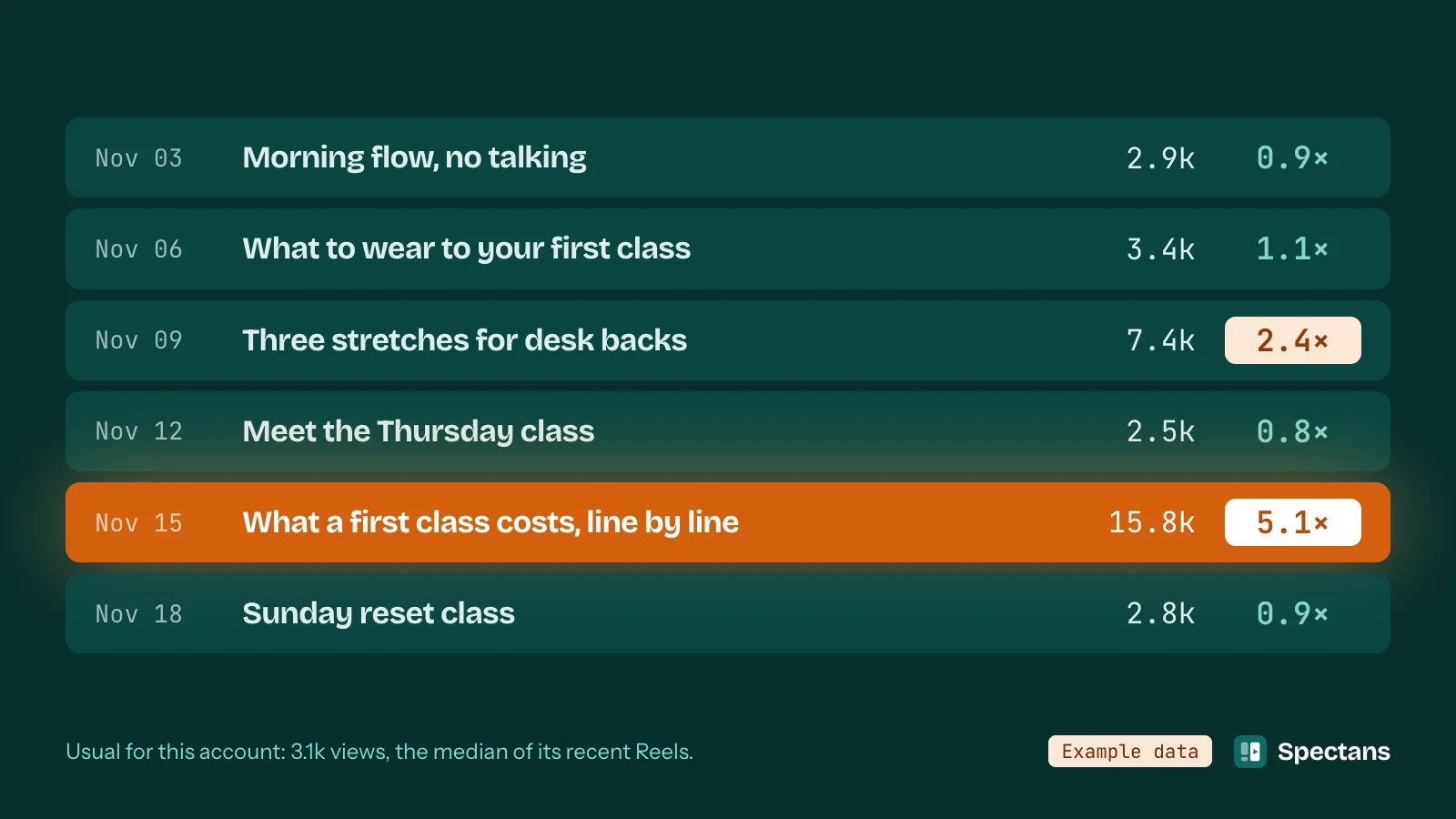
To find outlier posts by hand, list one account’s recent posts in a single format, take the median of their results, and divide each post’s result by that median. Posts that reach 2× or more beat the account’s usual and are worth studying. You need a spreadsheet and about 20 minutes an account.
This guide covers Instagram, TikTok and Facebook, including where the method breaks. If the term is new, start with what an outlier post is.
What you need
- A spreadsheet. Our outlier tracker template (CSV, opens in Google Sheets or Excel) has the columns ready.
- The numbers a visitor can see. No login to the account, no analytics access.
- A list of accounts. Your own, plus five to ten competitors that sell to the same people.
Step 1: Pick one account and one format
Work on one account and one format at a time. A Reel and a carousel are counted differently even on the same account: a Reel’s views are plays, and a carousel’s views are on-screen displays, as we explain in what counts as a view. Mixing them gives a usual that describes neither.
Step 2: Write down the recent results
Open the account’s profile and list its last 12 to 30 posts in that format, with the date and one result for each.
| Network and format | Result to write down | Notes |
|---|---|---|
| Instagram Reels | Views | The owner can hide like and view counts on a post. Skip posts where they are hidden. |
| Instagram photos and carousels | Likes plus comments | We found no Instagram page saying photo posts show a view count to visitors. |
| TikTok videos | Views | Use the count shown on the video. |
| Facebook Reels and videos | Views | Facebook says you can see the number of views on a public video. |
| Facebook photo and text posts | Reactions plus comments | Reaction totals stay visible on posts from Pages. |
Two things to leave out:
- Pinned posts. They sit at the top of a profile out of date order, and they are usually the account’s best. Leave them out of the baseline.
- Posts younger than a week. They are still collecting views. Step 5 explains why.
Step 3: Take the median
Sort the results from smallest to largest and take the middle one. With an even number of posts, take the two in the middle and halve their sum. In a spreadsheet: =MEDIAN(G2:G31).
Use the median, not the average. Several tools and guides use an average, and it breaks on the first viral post.
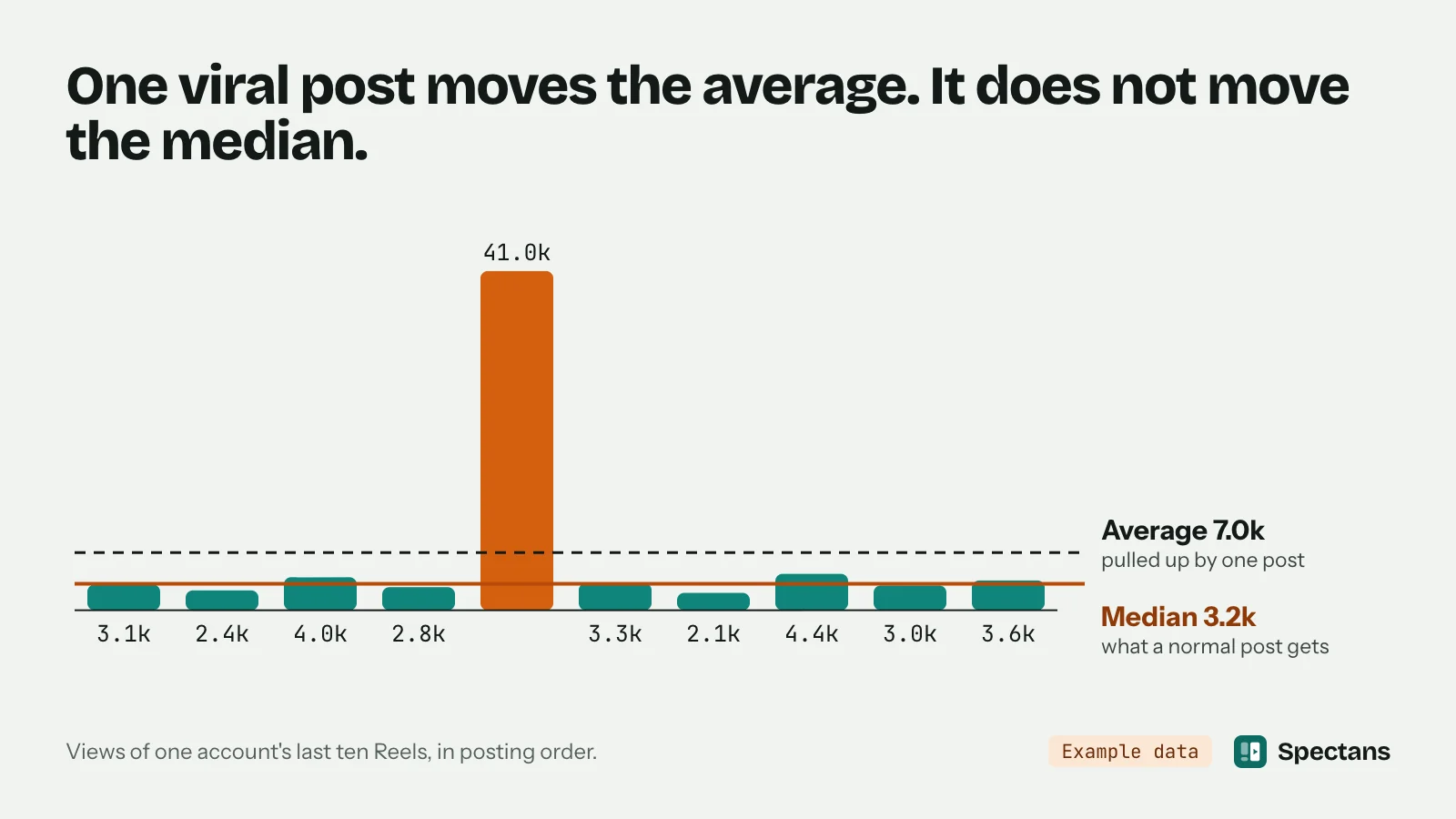
In the example, nine posts sit between 2,100 and 4,400 views and one reached 41,000. The average is 7,000, a number no ordinary post from this account reaches. Against that average, a good post with 6,400 views scores 0.9× and is missed. Against the median of 3,200 it scores 2.0×.
Step 4: Divide each result by the median
Outlier multiple = the post’s result ÷ the account’s usual
In the template the formula is =G2/K2. Or paste the numbers here:
Outlier calculator
Paste the results of an account’s recent posts in one format, then the result of the post you want to check. Nothing you type leaves this page.
One per line or separated by commas. 3.1k and 1.2M work too.
- Usual (median)
- 3,200
- Outlier multiple
- 2.3×
- Verdict
- Strong outlier (2× and up)
10 posts counted
Step 5: Compare posts at the same age
Views build over days. TikTok said in 2020 that a video’s performance extends over a couple of days, and its support pages note that analytics can take one to two days to update. None of the three networks publishes how long a post keeps collecting views.
That creates a trap. A post from two days ago, compared with posts that have had months, looks below usual when it may be ahead.
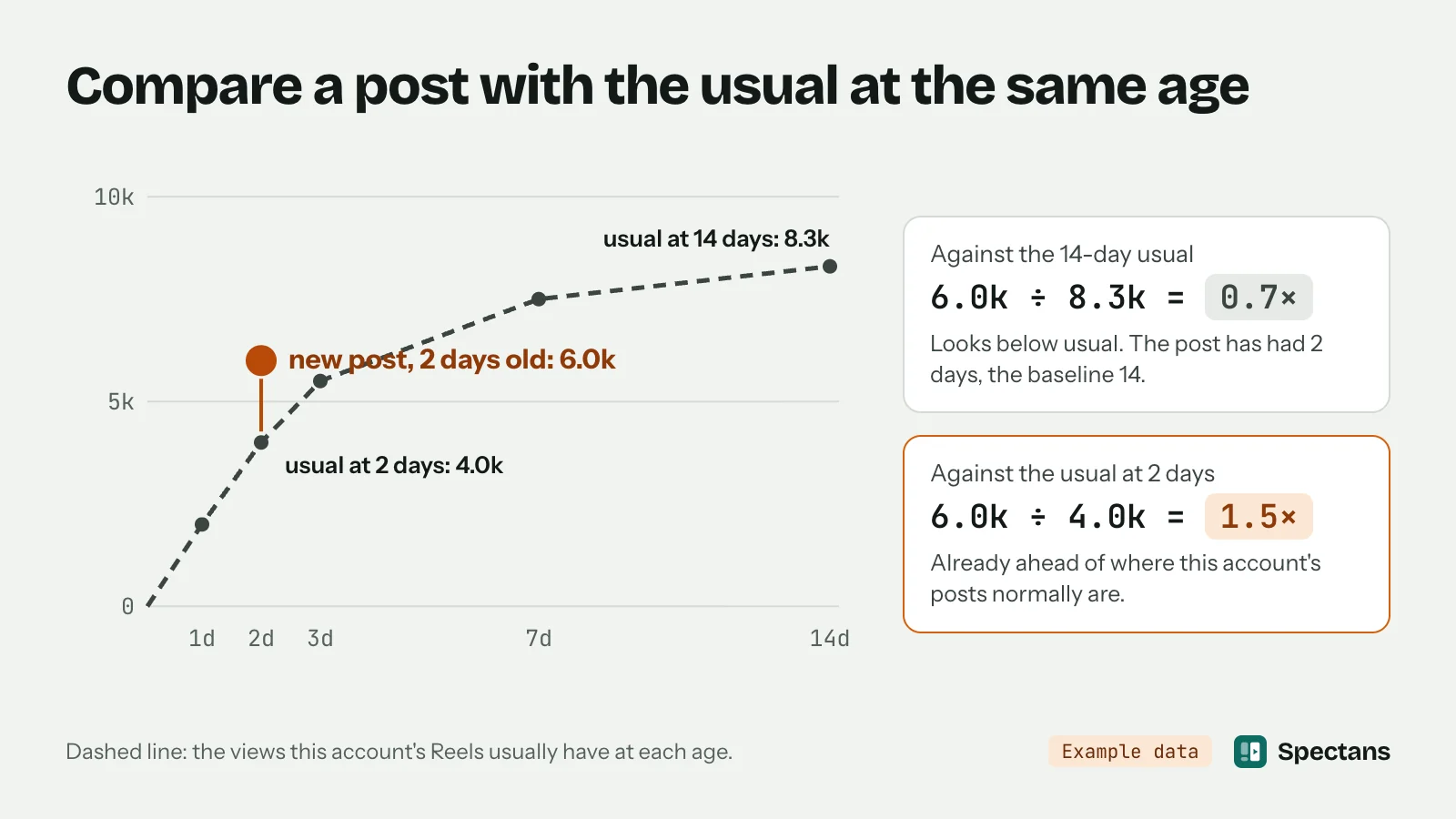
By hand there are two ways to handle it:
- The simple way. Score only posts that are at least 7 days old, or better 14. You lose speed and gain a fair comparison.
- The thorough way. Record each post’s result on fixed days after posting, and compare a 3-day-old post with what the account’s posts usually had at 3 days. This is what Spectans does, reading every post again at 1, 2, 3, 7 and 14 days. By hand it is a lot of return visits.
Step 6: Keep the posts at 2× or more
Mark each post with a tier and keep the strong ones.
| Multiple | Tier | What to do |
|---|---|---|
| Below 1.5× | Around usual | Nothing. |
| 1.5× to 2× | Mild | Note it. Act only if the same idea shows up again. |
| 2× to 5× | Strong | Study it. |
| 5× and above | Huge | Check for the causes below, then study it. |
Expect most posts to land below the line. ShortsIntel, a vendor, reports from its own sample of 619 TikTok videos from 48 creators that about one in five reached 2× the creator’s median, and that more than half were below the median. That is one vendor’s data from one network, so treat it as a rough guide.
Step 7: Record why it worked, then repeat
A multiple tells you that a post worked, not why. For each outlier, write down:
- The first line. What is said and shown in the first three seconds. See our guide to video hooks.
- The topic and the format. A talking head, a list, a before and after.
- The questions in the comments. They are often the next post. See content ideas from comments.
Then do the next account. The value arrives when you put the accounts side by side: an idea that beat the usual on three different accounts is a pattern, and one worth making yourself. Keeping these in one place is a swipe file.
Why not just compare views with followers?
A common shortcut calls a post an outlier when its views exceed the account’s follower count. It is a different test, and the two disagree often:
| Account | Views vs followers | Views vs its own usual |
|---|---|---|
| 1.2M followers, a post with 400k views, usual 90k | Not an outlier | 4.4× outlier |
| 3k followers, every Reel gets 5k to 6k views | Every post is an outlier | None is |
The follower test tells you whether a post travelled beyond the account’s audience. The usual test tells you whether this post did better than the account’s other posts, which is the question you need answered to learn from it.
How long this takes, and when to stop doing it by hand
One account in one format takes about 20 minutes the first time and 5 minutes a week after that. Ten accounts across three networks, with two formats each, is a working day to set up and a few hours every week. It also only tells you the multiple. Reading transcripts, grouping comments and checking ads are separate jobs.
That is the point where a tool earns its place. We build one, Spectans, and we compare the others fairly in outlier finder tools for Instagram, TikTok and Facebook. The method above is the same one a tool runs. Doing it by hand for a week or two is the best way to understand what the numbers mean before you automate them.
Questions
-
Can I find outlier posts without a tool?
Yes. You need a spreadsheet and the numbers each network shows on a public post. List an account’s recent posts in one format, take the median, and divide each result by it. It takes about 20 minutes an account, which is why people use tools once they track more than a few.
-
How many posts do I need to work out an account’s usual?
At least 10 in the same format, and 20 to 30 is better. With fewer than 10, one unusual post moves the median too much. Spectans uses the last 30 posts in a format from the past 365 days and waits for 10.
-
Should I compare views with followers instead?
It is a different test. Views above the follower count shows that a post travelled beyond the account’s audience. It misses outliers on large accounts, whose posts rarely exceed their followers, and it flags almost every post from a small account with strong reach. Comparing with the account’s own usual avoids both problems.
-
How old should a post be before I score it?
Old enough that most of its views are in. Scoring posts at least 7 days old, or better 14, is a safe rule by hand. If you want to score newer posts, compare them with what the account’s posts usually have at the same age.
-
What if an account hides its like counts?
Instagram lets an account hide like and view counts on its posts. Use the numbers that remain visible, such as Reel views or comments, or leave that account’s photo posts out. Do not mix a different metric into the same baseline.
-
How often should I repeat this?
Weekly is enough for most brands. New posts need a week or two to settle, and an account’s usual moves slowly. Keep the same thresholds every time so one week can be compared with the next.
Sources
We last read these pages on November 27, 2026.
- Hide or unhide like counts on Instagram posts and reels Instagram Help Center
- See views on a creator or friend’s reel on Facebook Facebook Help Center
- Total reactions on Facebook posts and reels Facebook Help Center
- Outlier videos statistics ShortsIntel
- My posts aren’t getting views TikTok Support
- 5 tips for TikTok creators TikTok Newsroom, 30 July 2020
In Spectans
- Outlier detection
Every tracked post ranked by how far it beat its own account’s usual, not by raw views.
- Competitor tracking
Track your own accounts and your competitors’ on Instagram, TikTok and Facebook from a profile link.
- Hook and video analysis
Each outlier taken apart: the hook, the structure, the transcript and what is on screen.